
November 2026 is one of the busiest months of the year for the night sky. The Leonid meteor shower peaks on the night of November 17 into the morning of November 18, Mars and Jupiter pair up before sunrise on November 15 and 16, the Beaver Moon on November 24 is the first of three supermoons in a row, and on November 18 NASA’s Voyager 1 becomes the first human-made object to sit one full light-day from Earth. Here is what to see, when to look and how to plan a simple stargazing night around it.
November 2026 night sky at a glance
These dates come from NASA’s November 2026 skywatching guide and the timeanddate.com sky guide for November 2026.
- Around Nov. 5: Southern Taurids peak, with the chance of an occasional bright fireball.
- Around Nov. 12: Northern Taurids peak, at roughly five meteors per hour under ideal conditions.
- Nov. 13: Mercury and Venus appear fairly close together before sunrise.
- Nov. 15–16: Mars and Jupiter appear about 1.2 degrees apart in the southeast before sunrise.
- Nov. 17–18: Leonid meteor shower peak, best before dawn on Nov. 18.
- Nov. 18: Voyager 1 reaches one light-day from Earth.
- Nov. 20: The waxing gibbous Moon passes near Saturn, and Mercury reaches its greatest western elongation in the morning sky.
- Nov. 24: Full Beaver Supermoon, which also passes near the Pleiades star cluster.
- Nov. 25: Uranus at opposition, best seen with binoculars or a telescope.
- Nov. 27: Venus reaches its brightest of 2026 in the pre-dawn sky.
- Nov. 30: The Moon, Jupiter and Mars gather near the bright star Regulus in Leo.
Leonid meteor shower 2026: when and where to look
The Leonids are November’s headline meteor shower. According to EarthSky, the shower is active from November 3 through December 2, and its peak is predicted for 0:00 UTC on November 18, 2026. The Farmers’ Almanac notes that the International Meteor Organization’s forecast puts the regular maximum at 23:45 UTC on November 17, so the two forecasts line up closely.
Best time to watch
Plan to watch late on the night of November 17 through dawn on November 18. The meteors appear to come from the constellation Leo, which rises around midnight in mid-November and is highest in the sky at dawn, so the pre-dawn hours are usually the most productive. NASA suggests trying the early mornings of November 17 and 18 after the Moon sets, and watching on both mornings gives you a backup if one night is cloudy.
How many meteors will you see?
Keep expectations realistic. Under a dark sky, NASA says the Leonids could produce around 15 meteors per hour at best, and most viewers will see fewer. The first quarter Moon falls at 11:48 UTC on November 17, according to EarthSky, so its light mostly affects the evening rather than the hours before dawn. A major meteor storm is not forecast this year.
The Leonids are famous because of what they have done before. EarthSky recounts the storm of November 17, 1966, when rates reached thousands of meteors per minute for about 15 minutes. Most years are far quieter, but this year has a bonus: bright Jupiter and reddish Mars sit near the shower’s radiant, so even a slow night gives you something to look at.
Mars and Jupiter meet before sunrise
On the mornings of November 15 and 16, look southeast before sunrise. NASA says Mars and Jupiter will appear about 1.2 degrees apart, a little more than the width of two full Moons side by side. Jupiter is the brighter point of light, with reddish Mars beside it, and both are easy to see without binoculars. Timeanddate.com lists November 16 as the night they are closest, and they stay fairly near each other all month, ending with a meet-up with the Moon near Regulus on November 30.
Voyager 1 reaches one light-day from Earth
The quietest event of the month may be the most remarkable. NASA says Voyager 1 will reach one light-day from Earth on Wednesday, November 18, 2026, at 5:16:07 a.m. EST (10:16:07 UTC). At that moment it will be about 16.094 billion miles (25.902 billion kilometers) away, according to NASA’s Voyager tracking page.
A light-day is the distance light travels in 24 hours. Once Voyager 1 passes it, a command sent from Earth takes a full day to reach the spacecraft, and its reply takes another day to come back. NASA’s light-day explainer says the trip will have taken 49 years, two months and 11 days since the spacecraft launched on September 5, 1977.
You can’t see Voyager 1, but you can look toward it. NASA says it is traveling in the direction of the constellation Ophiuchus, the Serpent Bearer, which NASA charts toward the western horizon around 5 p.m. on November 17. NASA is also running a “Shine Bright for Voyager’s Light-Day” activity on November 17, with details at nasa.gov/voyager.
The Beaver Supermoon on November 24
November’s full Moon is traditionally called the Beaver Moon, and this year it is also a supermoon. According to Space.com, it turns full at 9:53 a.m. EST (14:53 UTC) on November 24. That is 2:53 p.m. in London, 10:53 p.m. in Beijing, 11:53 p.m. in Tokyo and 1:53 a.m. on November 25 in Sydney.
In North America the Moon is below the horizon at the exact moment it turns full, so the best views are the evenings of November 23 and 24, when it rises looking full in the east around sunset. Space.com notes that a supermoon can look up to 14% larger and 30% brighter than the smallest full Moon of the year, though NASA says the difference is subtle in practice. The giant look near the horizon is the Moon illusion, which happens with any full Moon. NASA adds that this is the first of three supermoons in a row, in November, December and January.
How to plan a stargazing night this November
You don’t need a telescope for most of this month’s highlights. A few simple steps make a big difference:
- Get away from city lights. Light pollution is the biggest reason people see fewer meteors. A park, beach or rural lookout an hour from town can turn a dull night into a good one, and it pairs well with one of these weekend nature escapes.
- Give your eyes time. NASA recommends letting your eyes adjust to the dark for about half an hour, and taking in as much of the sky as you can rather than staring at one spot.
- Dress for a cold pre-dawn. The best Leonid hours are the coldest of the night. Bring layers, a reclining chair or sleeping pad, and a warm drink. If you’re new to overnight trips, our camping gear guide for beginners covers the basics.
- Use binoculars for extras. They are handy for Uranus at opposition on November 25 and for the Pleiades near the full Moon on November 24.
- Try a photo. A phone on a tripod with night mode, or a camera with a wide lens and a long exposure, can catch meteors and the rising supermoon. For composition tips, see Mastering Nature Photography.
Frequently asked questions
What is the best night to see the Leonids in 2026?
The night of November 17 into the early morning of November 18. The peak is forecast for around 23:45 UTC on November 17 to 0:00 UTC on November 18, and the hours before dawn are usually best.
Is the November 2026 full Moon a supermoon?
Yes. The Beaver Moon on November 24, 2026 is a supermoon and the first of three in a row, according to NASA.
When does Voyager 1 reach one light-day from Earth?
On November 18, 2026, at 5:16:07 a.m. EST, when it will be about 16.1 billion miles away, according to NASA.
Can I see Mars and Jupiter without a telescope?
Yes. Both are easy to see with the unaided eye. Look southeast before sunrise on November 15 and 16, when they appear about 1.2 degrees apart.
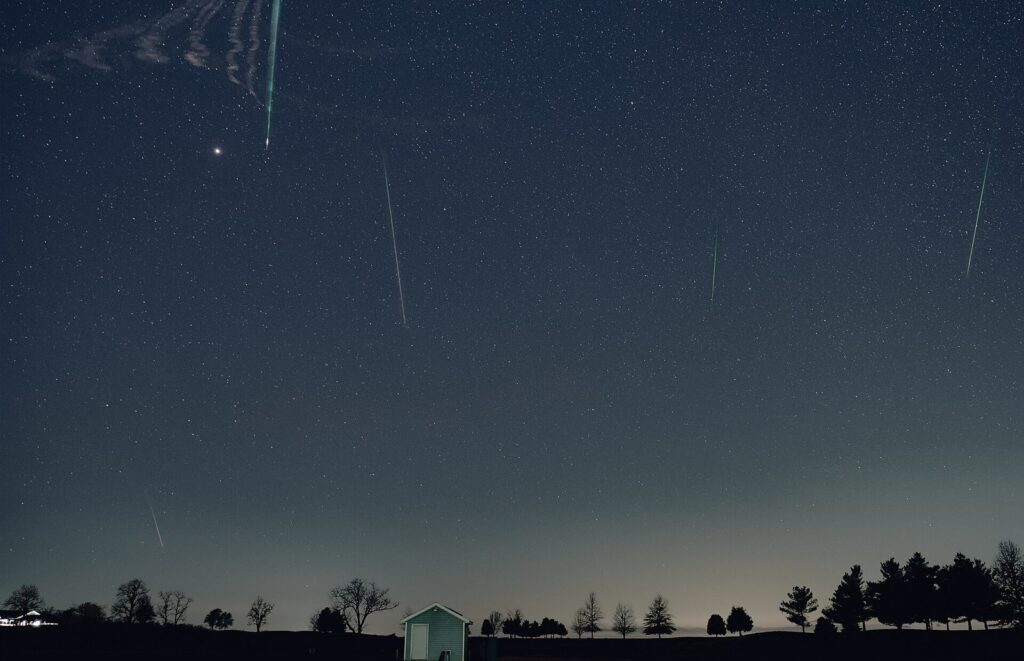
Featured image: Composite of five Leonid meteors, photo by Jim Vajda, CC BY 2.0, via Wikimedia Commons (cropped).