
The biggest travel story of 2026 isn’t where people are going. It’s how they’re deciding. The new WTM Global Travel Report, released on November 3 at WTM London with research firm Tourism Economics, says international travel will still hit a record this year, with about 1.57 billion overnight arrivals. But travelers are hunting harder for value, staying closer to home, shifting their dates and, more and more, letting AI help with the planning. Here’s what the report found and what it means for your next trip.
The headline numbers: a record year, but slower growth
According to TravelPress’s summary of the report, international overnight arrivals are projected to reach 1.57 billion in 2026, up 2% on 2025. Spending by those visitors should rise 6% to about US$1.8 trillion. Counting domestic and international trips together, the report expects 24.2 billion visitor nights and US$7.8 trillion in spending.
That’s still a record, but growth has cooled sharply. Tourism Economics puts this year’s rise at just 2%, compared with 6% in 2025. The report points to three main reasons: the Iran conflict, higher jet fuel prices and the cost of living.
7 travel trends from the WTM Global Travel Report 2026
1. Value for money is now a top reason to pick a destination
This is the clearest shift in the data. In 2026, about one in six travelers chose their last international destination mainly for value for money, up from around one in eleven in 2025. The share picking a destination for luxury stayed steady at 12%.
2. Save here, splurge there
Budget travel and luxury travel are both growing at once. In Tourism Economics’ surveys, 56% of respondents said they’re interested in mixing the two: saving on some parts of a trip so they can spend more on the parts they care about. Think a simple guesthouse paired with one unforgettable dinner or guided excursion. At the show itself, Chase Gray of Skift Advisory described the future of luxury as “access, not excess,” TravelMole reported.
3. Short-haul trips are winning
Long-haul demand took a hit this year from safety concerns, higher fares and lost capacity. The report notes that Gulf hubs handled about 15% of global transit traffic in 2025. Inter-regional trips fell by 3% globally, while short-haul travel rose by the same amount, especially within Europe and Sub-Saharan Africa. FTN News reports that arrivals are forecast to grow 8% in Africa and Oceania and 5% in Europe this year, partly because travelers are choosing places away from conflict and aviation disruption.
If you’ve been leaning toward shorter, closer getaways, you’re in good company. Our guide to weekend nature escapes has ideas that don’t need a long flight.
4. More people want to switch off
The need to disconnect and relax is now the main travel motivator for 37% of survey respondents, up from 31% in 2025. Connecting with local communities and with nature also remains popular. It’s a theme we keep coming back to in our piece on digital detox travel.
5. Off-peak travel keeps growing
About 22% of respondents said they now plan to travel at different times of year than they used to. Interestingly, the main reason is saving money, ahead of cooler weather or avoiding crowds.
6. Adventure travel has a big “wish vs. do” gap
Almost two-thirds of travelers (64%) said they’re interested in adventure trips, but fewer than one in five (19%) usually take one. The report suggests better packaging and more family-friendly options could close that gap. If adventure is on your someday list, our guide to adventure travel is a good starting point.
7. AI is moving from search to booking
More than a third of people (36%) say they would now trust AI to complete a travel booking for them. Even more would use it to get recommendations (53%) or to search and compare prices (58%). Tourism Economics says being discoverable by AI assistants is now an immediate priority for destinations and travel companies.
Sustainability is shifting from talk to action
A separate study released on November 4 points the same way. Trip.com Group’s 2026 Sustainable Travel Consumer Report, based on 8,777 respondents across 29 markets, found that 75.4% of travelers say sustainability matters when they make travel decisions, and 56.8% now intentionally choose more sustainable options, TTR Weekly reported. Price is still the biggest barrier, cited by 37.1%.
The same survey found that 62% of travelers had changed at least one part of a trip because of extreme weather, from delaying the trip to switching destinations. For simple ways to travel lighter, see our eco-tourism guide.
What about travel to North America and the Middle East?
Despite hosting the FIFA World Cup, North America is forecast to end 2026 with international arrivals up just 2%, still 6% below 2019 levels. The report cites rising costs and negative traveler sentiment toward the United States. It sees the LA 2028 Olympics as a bright spot ahead.
Overnight arrivals to the Middle East were down 40% this year. Tourism Economics projects a rebound of 43% in 2027 if the Iran conflict ends.
What it means for your next trip
- Be flexible on dates. With more travelers shifting to off-peak periods for value, shoulder seasons are worth a look before you lock in a peak-week trip.
- Look closer to home. A short-haul or domestic trip can dodge higher long-haul fares and still deliver the rest and nature time most people say they want.
- Decide where to splurge. Pick the one or two experiences that matter most and save on the rest.
- Use AI tools, but double-check. AI can speed up price comparisons and ideas. Confirm prices, dates and cancellation terms directly before you pay.
- Book around big events early. The report found 58% of international travelers had taken an overseas trip to attend an event in the past two years, according to TravelMole, so expect higher prices near concerts and major sports dates.
Will travel bounce back in 2027?
The report is optimistic. If this year’s disruption eases, global international arrivals are expected to grow 8% in 2027, with long-haul travel rebounding 11%. After that, Tourism Economics expects growth of around 6% a year, reaching 2.2 billion arrivals by 2032, driven in part by growing travel from markets like India and China.
FAQ
What is the WTM Global Travel Report?
It’s an annual report released at WTM London, one of the travel industry’s biggest trade shows, produced with Tourism Economics, an Oxford Economics company. The 2026 edition was released on November 3, and the show runs November 3 to 5 at ExCeL London.
Is international travel growing in 2026?
Yes, but slowly. Arrivals are projected to rise 2% to a record 1.57 billion, down from 6% growth in 2025.
What is the biggest travel trend of 2026?
Value-seeking stands out. About one in six travelers picked their last international destination mainly for value for money, up from about one in eleven a year earlier.
Do people trust AI to book travel?
Some do. 36% of people surveyed said they would trust AI to complete a travel booking, and 58% would use it to search and compare prices.
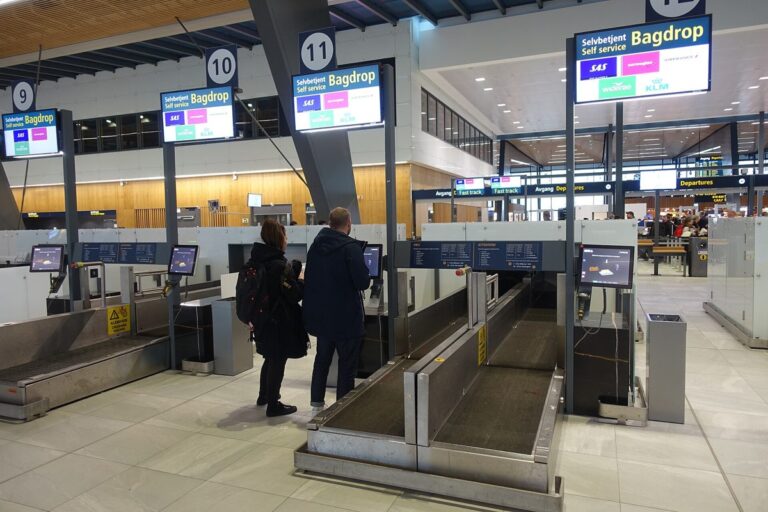
Featured image: Self-service bag drop at Bergen Airport Flesland, Norway, by Wolfmann, licensed under CC BY-SA 4.0 via Wikimedia Commons, resized.