
Yes — forecasters say the Arctic polar vortex has been disrupted at the earliest point in a calendar year on record, with a sudden stratospheric warming (SSW) underway in early November 2026. That does not mean a nationwide freeze arrives overnight. FOX Weather, DTN and NOAA’s Climate Prediction Center all stress that surface impacts, if any, usually lag by weeks, while a strengthening El Niño still favors a milder-than-average November across much of the United States. Here’s what the science says, what it means for Thanksgiving travel, and how to plan without the social-media panic.
What Happened to the Polar Vortex in November 2026?
According to FOX Weather (updated Nov. 6, 2026), the polar vortex — a band of strong winds circling the North Pole roughly 10 to 30 miles up in the stratosphere — has been disrupted earlier than any previously recorded major event in the modern satellite era. Seasonal waves from the lower atmosphere can weaken, displace or split that circulation and, in strong cases, reverse its usual westerly winds.
DTN meteorologist John Baranick described the same setup on Nov. 3: the developing stratospheric vortex is splitting, with one lobe shifting toward Russia and another toward Canada, while a high-pressure ridge builds over the Pole. Events like this are called sudden stratospheric warmings. Most SSWs hit in mid-to-late winter; an early-November case is rare enough that NOAA’s November outlook discussion flagged it as a source of extra uncertainty for the eastern U.S.
Does an Early Polar Vortex Split Mean Immediate Cold?
Short answer: no. Stratospheric changes do not slam into your backyard the next morning. FOX Weather notes it can take several weeks for the disruption to work downward into the jet stream. The FOX Forecast Center said models still show no major cold-air outbreak in the near term, with the coldest air pooling over Eastern Europe and Siberia while North America stays warmer than average.
Baranick’s DTN analysis is even more cautious for U.S. travelers: Arctic source regions are unusually mild, El Niño keeps a ridge over North America and a trough near Alaska/the Aleutians, and many long-range models keep the SSW largely confined to the stratosphere before the vortex strengthens again by late November. An early cold blast around Thanksgiving is possible to watch for, he wrote, but it faces “major headwinds” and is not the most likely outcome.
El Niño vs. the Polar Vortex: Why the U.S. Outlook Stays Mild
Climate.us, summarizing NOAA’s Climate Prediction Center outlook published around Nov. 3, reports that no part of the contiguous U.S. or Alaska is favored for a cooler-than-average November. Only Arizona, New Mexico and Texas sit in an “equal chances” zone; the rest of the country leans warm, with the highest odds of above-normal temperatures across the northern tier.
Precipitation leans wetter than average across large parts of the Lower 48 and southern coastal Alaska, especially the Southwest and parts of the Upper Midwest, while western Alaska, the Northern Rockies and parts of Michigan lean drier. NOAA’s discussion names El Niño as the dominant driver and notes that a November SSW — if it couples to the surface — can favor a negative Arctic Oscillation for weeks afterward, which can compete with El Niño signals in the East. That tug-of-war is why eastern travelers should treat late-November forecasts as more changeable than usual, not as a guaranteed blizzard.
FOX Weather also expects a rapidly strengthening El Niño — potentially a Super El Niño declaration later this year — to keep feeding a strong Pacific jet that imports mild Pacific air and storms, making prolonged Arctic air hard to lock in through December.
What This Means for Thanksgiving 2026 Travel
Thanksgiving Day falls on Thursday, Nov. 26, 2026. An October Weather.com aviation disruption outlook — framed around El Niño seasonal signals, not a single storm — is useful for trip planning even though the polar-vortex story evolved after that piece:
- Great Lakes / Upper Midwest hubs (Chicago, Detroit, Minneapolis): below-normal weather-delay risk versus a typical November, thanks to milder odds and fewer early-season snow/ice threats.
- Northeast: near-normal risk.
- Southeast, Florida and Gulf Coast / Texas hubs (Atlanta, Charlotte, Orlando, Miami, Houston, Dallas, New Orleans): elevated rain/thunderstorm delay risk — Atlanta’s role as a connecting hub can ripple nationwide.
- California: elevated risk later in the month as Pacific storm chances rise, especially around San Francisco.
- Pacific Northwest: below-normal weather-delay risk in that seasonal outlook.
In plain terms: do not scrap northern road or air trips because of polar-vortex headlines. Do build buffer time if you connect through the wetter South, and re-check forecasts in the week before you leave. If you are planning a quieter late-fall break instead of a packed holiday dash, our guide to stillcation-style do-less travel pairs well with a milder, less snowbound northern pattern.
How to Plan Smart Without Overreacting
- Treat social posts as tips, not forecasts. DTN explicitly warned that “armchair meteorologist” content often oversells an automatic U.S. freeze after any SSW.
- Watch late November and early December, not this weekend. If surface coupling happens, FOX Weather and DTN both point toward roughly Thanksgiving-to-December timing — still uncertain.
- Book flexible tickets when connecting through elevated-risk hubs (ATL, Florida, Texas Gulf, late-month California).
- For road trips, prioritize tire, battery and kit checks even in a mild outlook; brief cool spells remain possible. Scenic winter drives still reward preparation — see our ideas for mountain getaways if snow is part of the plan.
- Use the mild nights. A warmer northern November can mean clearer evening skies for the November 2026 Leonids and Beaver supermoon if local clouds cooperate.
- Keep an eye on value and timing trends from the broader 2026 travel trends report — off-peak travel still helps when weather windows shift.
Frequently Asked Questions
Is the 2026 polar vortex disruption the earliest on record?
FOX Weather reports the disruption as the earliest in a calendar year on record based on FOX Forecast Center analysis. DTN likewise calls the developing SSW the earliest in the short history of stratospheric observations. Exact ranking details can evolve as the event completes.
Will the polar vortex make Thanksgiving 2026 bitterly cold?
It is not the most likely outcome right now. El Niño favors above-average temperatures for much of the U.S. through November, and models have not locked in a major cold outbreak. A late-month or December cool spell is the window to watch, not a sure thing.
What is a sudden stratospheric warming (SSW)?
An SSW is a rapid warming high above the Arctic that can weaken or reverse stratospheric polar winds. It sometimes — not always — leads to colder mid-latitude weather weeks later.
Which U.S. regions face the highest Thanksgiving weather-delay risk?
Weather.com’s seasonal outlook flagged elevated risk for Southeast, Florida, Gulf Coast/Texas and late-month California travel, with below-normal risk for many Great Lakes and Pacific Northwest hubs.
Should I change my Thanksgiving flights because of polar vortex news?
Not solely because of the headline. Reassess if you connect through storm-prone southern hubs, keep flexible change policies when you can, and refresh the forecast 3–7 days out.
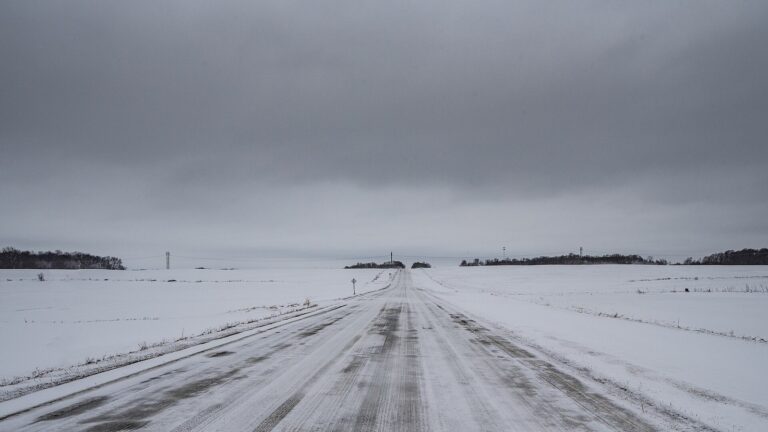
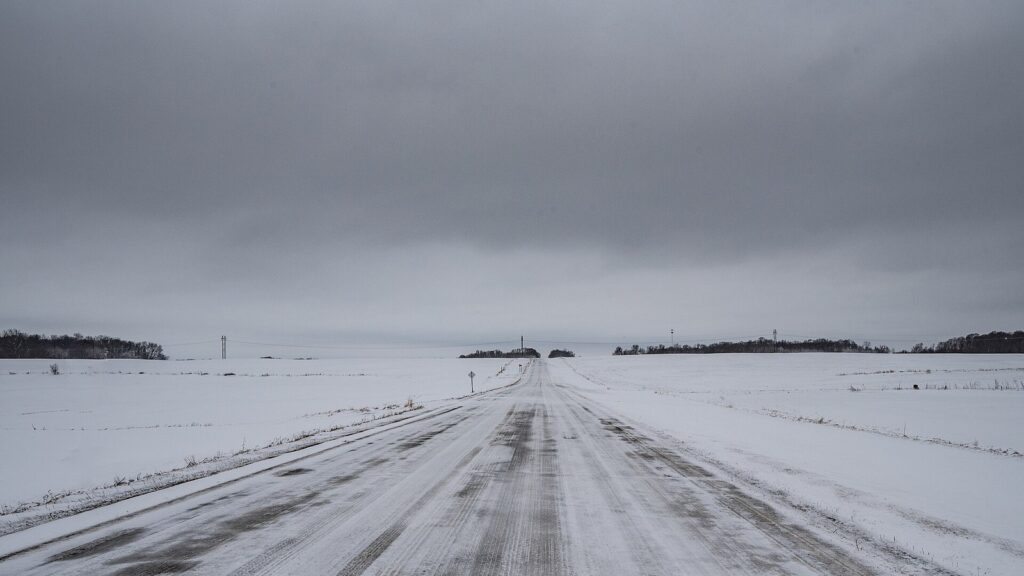
Featured image: Snow-covered road and farms in rural Minnesota by Tony Webster, via Wikimedia Commons, CC BY-SA 2.0, cropped.